Infrastructure Project Management for Airports, Railways, and Metro Projects
Large infrastructure projects like building new airports, laying railway tracks, or constructing metro systems are some of the most exciting—and challenging—jobs in the construction world. These mega projects come with massive budgets, tight schedules, hundreds of workers, and strict safety and quality rules. For contractors, success depends on one thing: strong project management.
In this blog, we break down the entire process in simple, easy-to-understand language. Whether you are a small contractor handling your first metro station or an experienced firm managing a full airport terminal, these steps will help you stay organised, control costs, and deliver projects on time. No jargon, no sales talk—just practical advice that works for any infrastructure project.
A Practical Guide for EPC Contractors and Construction Firms
1. Winning the Bid: Tender and Contract Management
Every big project starts with a tender notice from the government or a private client. This is your chance to win the job.
Smart contractors treat bidding seriously. They carefully study the tender documents, prepare a detailed Bill of Quantities (BOQ) that lists every single item of work—from earth excavation to signalling systems—and create a realistic cost estimate. They keep track of different versions of their bid so they can make quick improvements. Before submitting, they run an internal review and approval process to avoid mistakes.
Once the tender is awarded, the winning bid automatically becomes the foundation of the new project. This smooth start saves time and prevents errors later.
2. Setting Up the Project Right from Day One
Winning the contract is great, but the real work begins with proper project setup.
You need to create the project file with the exact contract value and decide how much money will be held back as retention (the amount kept until the end). Break the entire job into a clear Work Breakdown Structure (WBS) so everyone knows what needs to be done and when. Track project stages so the whole team stays on the same page.
A well-set-up project gives you complete control over budget, timeline, and quality from the beginning.
3. Managing the Bill of Quantities (BOQ)
The BOQ is the heart of any infrastructure contract. It lists every piece of work—civil structures, railway tracks, airport runways, station buildings, electrical systems, and more.
Good practice is to create a detailed BOQ for each project and link every line to your cost calculations (materials, labour, machinery, subcontractors). Keep a history of all revisions so you can see changes over time. Regularly compare planned quantities with actual work done. This early warning system helps you catch problems before costs spiral out of control.
4. Job Costing: Knowing Exactly Where Your Money Goes
Before you spend a single rupee, you must know how much everything will cost.
Create a detailed job cost sheet for the project. Break it down into clear categories: materials, labour, plant and machinery, subcontractors, and overheads. Turn this sheet into a proper estimate that you can share with the client if needed. Update the cost sheet regularly so you always know whether you are making profit or facing losses on each activity.
This simple habit is one of the biggest reasons successful contractors stay profitable on mega projects.
5. Turning Plans into Action: Job Orders and Execution
Now it is time to start actual work. Break the project into smaller job orders.
Each job order lists clear tasks, start and finish dates, required materials, equipment, and labour. You can raise material requests or purchase orders directly from the job order. Record timesheets, note any risks or incidents, and allocate equipment. If something changes during execution, create a change order right there so nothing gets missed.
This step keeps daily work organised and aligned with the main contract.
6. Working with Subcontractors Smoothly
Almost every big airport, railway, or metro project involves many subcontractors. Treat them as part of your extended team.
Create separate job orders for each subcontractor, track their deliverables, and let them raise their own material requests. Issue Interim Payment Certificates (IPCs) to them quickly—many contractors now allow portal access so subcontractors can submit their claims easily. When you receive their bills, automatically deduct retention and adjust any advances. Clear communication and timely payments keep subcontractors motivated and projects moving fast.
7. Getting Paid on Time: Customer Billing and IPC Management
Cash flow is the lifeblood of every contractor. In infrastructure projects, clients pay through Interim Payment Certificates (IPCs).
Measure the actual work completed each month, prepare an IPC showing the value of work done, and handle deductions for retention and previous advances. The approved IPC then becomes the basis for the customer invoice. Some projects allow billing based on actual costs from vendor bills or purchase quantities—this keeps everything transparent and reduces disputes.
8. Progress Billing Directly from Job Cost Sheets
For contracts that allow cost-based billing, pull information straight from your approved job cost sheet. Check quantities and costs in real time, then create the progress invoice. This method is especially useful in complex railway or airport projects where work keeps changing.
9. Controlling Materials and Procurement
Materials can eat up 50–60% of your project cost. Control them tightly.
Use a proper workflow: raise material requisitions with approvals, create requests for quotations (RFQs), issue purchase orders, and match every vendor bill to the job cost sheet. Track how much material is actually used and compare it with the BOQ quantities. This stops wastage and keeps your budget under control.
10. Managing Equipment and Maintenance
Heavy machines like excavators, cranes, and tunnel borers are expensive and critical.
Allocate equipment to specific job orders, track usage costs, and raise maintenance requests before problems occur. Record any breakdowns and analyse downtime. Good equipment management prevents costly delays on busy airport runways or metro corridors.
11. Handling Changes: Change Orders and Variations
Scope changes are normal in big projects—new designs, unexpected site conditions, or client requests.
Document every change, show its impact on cost and time, get client approval through a proper process, and bill variations separately. This protects your profit and keeps relationships smooth.
12. Quality Checks: Job Order Inspections
Quality is non-negotiable in infrastructure work.
After completing each task, inspect the work, check it against drawings and standards, and record any defects. Only approve when everything is correct. This habit reduces rework and protects you from future claims.
13. Keeping Everyone Informed: Notes, RFIs, Transmittals, and Daily Logs
Clear communication prevents small issues from becoming big problems.
Use project notes and job order notes to record decisions, risks, and instructions.
Raise RFIs (Requests for Information) when you need clarification on drawings or specifications.
Manage transmittals and submittals for drawings, method statements, and material approvals.
Maintain daily logs recording manpower, equipment, materials, weather, and progress—attach photos for proof.
All records stay in one central place for easy reference during audits or reviews.
14. Document Management: Everything in One Place
Infrastructure projects create thousands of documents—contracts, drawings, invoices, test reports. Link every document to the right job order or cost sheet. This makes retrieval fast and keeps your project audit-ready.
Infrastructure Project Lifecycle Workflow
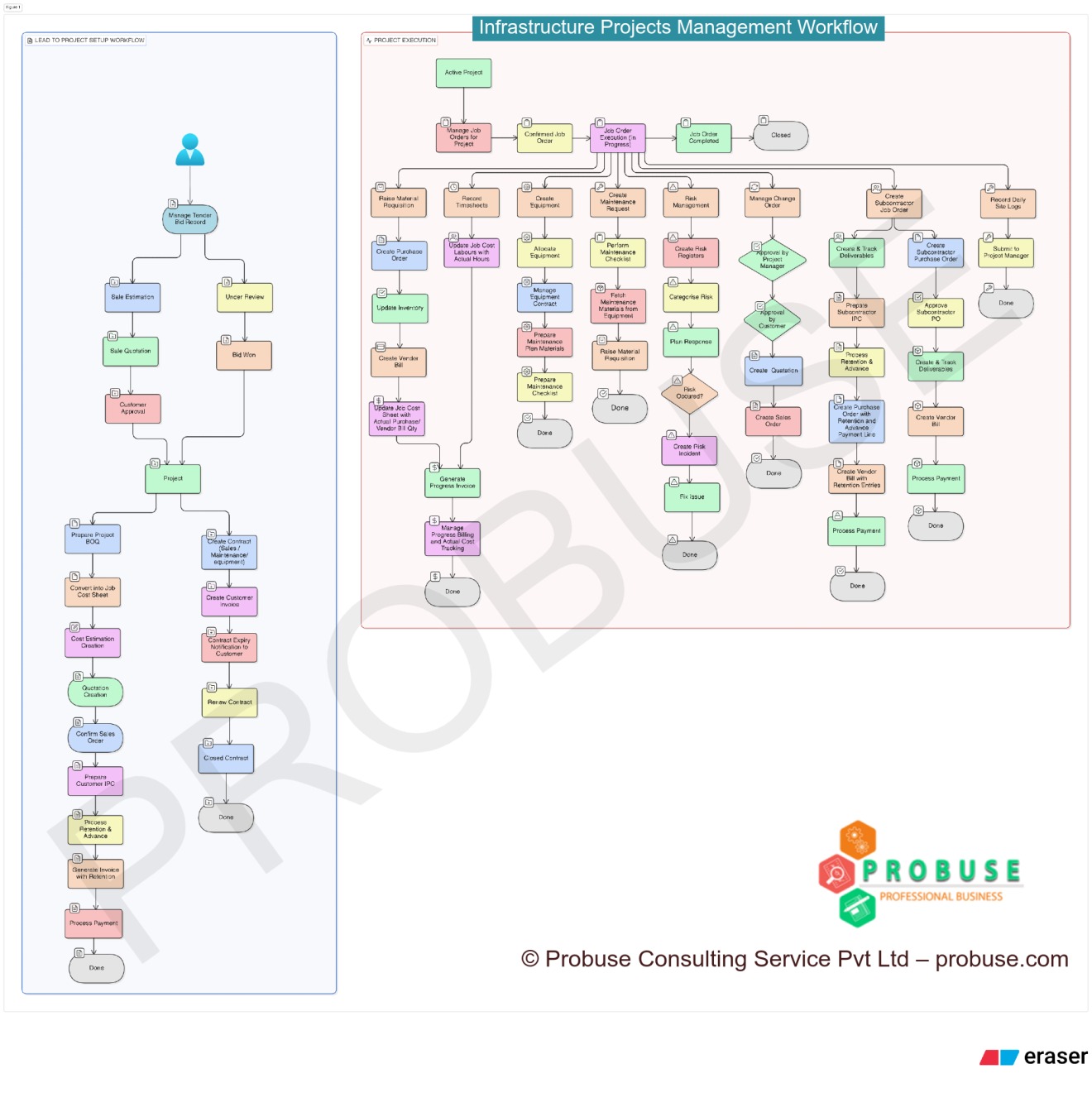
Every infrastructure project follows a clear flow, even though it may look complex from the outside. From the first tender to final billing, each stage is connected and builds on the previous one.
It usually starts with a tender announcement from a government authority or private client. The opportunity is reviewed, key details are captured, and the team decides whether to participate. Once approved, the estimation process begins—studying drawings, preparing the BOQ, and calculating expected costs for materials, labour, equipment, and overheads.
After internal reviews, the bid is submitted. If awarded, it turns into a formal contract with defined scope, timelines, payment terms, and retention conditions. At this stage, the financial structure of the project is set, and execution begins.
The project is then divided into smaller job orders or work packages. These help teams manage daily activities like material planning, procurement, labour tracking, and equipment usage. Costs are recorded continuously, giving a clear picture of how the project is performing.
As work progresses, billing is done in stages through Interim Payment Certificates (IPCs), based on actual completed work. At the same time, subcontractors are managed, risks are tracked, and any changes in scope are handled through proper approvals.
Throughout the project, daily logs, documents, and communication records are maintained to ensure transparency and smooth coordination between all teams.
Finally, once the work is completed, final billing is done, retention is released, and the project is formally closed.
In simple terms, infrastructure project management is about connecting all these steps—planning, execution, tracking, and billing—into one smooth and controlled workflow.
The Real Value of Good Project Management
Good infrastructure project management is not only about control. It also creates confidence.
When project data is organized, contractors can make better decisions. Site teams know what to do. Finance teams know what to bill. Procurement teams know what to buy. Management can see where the project stands. Clients also get better visibility into progress and payments.
In simple words, a well-managed project is easier to run, easier to monitor, and easier to finish successfully.
Conclusion
Infrastructure projects such as airports, railways, and metro systems are major investments and require careful planning from start to finish. They involve contracts, BOQs, job costing, procurement, subcontractors, progress billing, equipment, documentation, and constant coordination.
Because of this, contractors need a clear and organized project management approach. When all project information is connected and tracked properly, the work becomes more transparent, more efficient, and easier to control.
Success in infrastructure is not just about building—it’s about managing every step carefully.
Strong planning today prevents costly problems tomorrow.